
 Back
Back
A convincing fake no longer has to arrive as a suspicious video file. It can appear inside a job interview, customer support call, account-opening flow, payment approval, or live meeting. That changes what enterprises need from the best deepfake detection software. Detection accuracy matters, but so do media coverage, real-time performance, deployment options, privacy, explainability, and the ability to fit into an existing risk workflow.
This comparison focuses specifically on enterprise use. The tools are ordered by breadth of fit rather than claiming that one vendor is universally superior. A bank screening voice calls has different requirements from a media organization authenticating uploaded footage or an identity provider protecting remote onboarding.
Key takeaways
- The strongest enterprise tools differ significantly in scope. Some focus on live identity and video streams, while others specialize in media forensics, contact center audio, or high-volume content moderation.
- Multimodal support matters when attackers can combine synthetic faces, cloned speech, manipulated documents, and injected video in the same fraud attempt.
- A deepfake score should rarely be the only decision signal. Automated media analysis works better when combined with capture integrity, authentication controls, and manual review for higher-risk cases.
- Enterprises should test products against their own compressed media, devices, languages, network conditions, and attack types rather than relying on one advertised accuracy figure.
- Provenance and Content Credentials can provide useful authenticity signals, but they complement rather than replace forensic detection.
How we evaluated deepfake detection tools
A useful enterprise comparison needs to look beyond whether a vendor has a product labelled “deepfake detection.” The more important question is where that detection fits into an operational decision.
We assessed the tools against six practical criteria: supported media, real-time capabilities, deployment model, integration options, explainability, and intended enterprise workflow. We also considered whether the technology concentrates on post-capture forensic analysis or prevents synthetic media from entering a trusted identity or communication session in the first place.
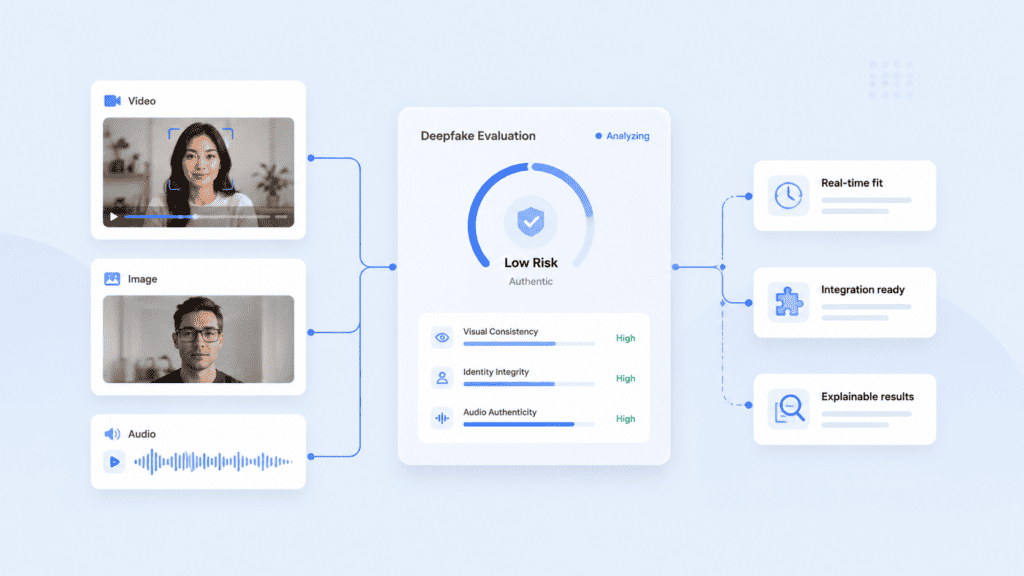
That distinction matters. NIST’s current identity-proofing guidance calls for digital media to be examined for manipulation and forgery indicators. It also recommends controls such as passive detection, sensor authentication, and testing against known attack artifacts. See the NIST Digital Identity Guidelines for identity proofing for the underlying guidance.
| Tool | Strongest fit | Video | Images | Audio | Real-time focus |
| PrivateID MediaSafe | Identity and live video workflows | Yes | Yes | Limited focus | Yes |
| Reality Defender | Broad enterprise communications | Yes | Yes | Yes | Yes |
| GetReal Security | Identity attacks and live impersonation | Yes | Yes | Yes | Yes |
| Sensity AI | Forensic media verification | Yes | Yes | Yes | File analysis + integrations |
| Pindrop | Voice, calls, and meetings | Yes | No primary focus | Yes | Yes |
| Hive | High-volume content detection APIs | Yes | Yes | Yes | API-centric |
| Resemble AI DETECT-2B | Synthetic voice detection | No | No | Yes | Yes |
| Attestiv DeepScan | File validation and video forensics | Yes | Yes | Yes | Primarily submitted media |
| DuckDuckGoose AI | KYC and identity fraud | Yes | Yes | Yes | Yes |
| Clarity | Enterprise media authentication | Yes | Yes | Yes | Yes |
Best deepfake detection software: 10 enterprise tools
1. PrivateID MediaSafe
PrivateID MediaSafe is particularly relevant when deepfake detection needs to operate inside a live identity or video workflow rather than as a separate file-checking utility. MediaSafe combines video-stream facial identification and tracking with deepfake detection for use cases involving video conferencing, streaming, access, and identity-related workflows.
The distinction is important for enterprises that already need to answer questions such as “Is this a real person?”, “Is this the same person we enrolled?”, and “Has this video stream been manipulated?” Detection becomes part of a broader trust decision instead of an isolated synthetic-media score.
PrivateID’s wider approach also includes passive, on-device liveness detection for presentation attacks such as screen replays, masks, and deepfake video. The liveness checks can run on the user’s device rather than requiring facial imagery to be sent away for server-side processing.
Best fit: Enterprises that need privacy-focused deepfake detection alongside biometric identity, liveness, or continuous video analysis.
2. Reality Defender
Reality Defender is one of the broader top deepfake detection companies for organizations that need to cover several communication channels. Its platform targets synthetic and manipulated video, audio, and images and is intended for workflows including contact centers, video conferencing, user verification, and executive impersonation.
The platform uses multiple detection models rather than depending on a single classifier. Development teams can also integrate detection into applications and workflows through APIs and SDKs, making it relevant when suspicious media needs to be evaluated automatically rather than uploaded manually.
That makes it a strong general-purpose option when the same enterprise may need to examine a suspicious recording today and protect a live communications channel tomorrow.
Best fit: Large organizations looking for multimodal detection across communications, fraud, and media-verification workflows.
3. GetReal Security
GetReal Security approaches deepfakes as an identity-security problem. Its platform analyzes manipulated image, audio, and video content while also focusing on impersonation and continuous identity verification during digital interactions.
Its use cases include remote hiring, executive impersonation, contact centers, IT service desks, and video meetings. This is useful when the security team is less interested in asking “Was this file generated?” and more interested in “Is the person controlling this interaction really the person they claim to be?”
GetReal also emphasizes forensic context around detections. That can be valuable where an incident may need to be investigated after the fact rather than simply blocked in real time.
Best fit: Security teams protecting remote workforce, executive, help-desk, and other high-trust human interactions.
4. Sensity AI
Sensity is built around forensic analysis of images, video, and audio. Its technology can examine submitted media using detection methods for face manipulation, AI-generated content, synthetic voice, and file anomalies.
For organizations comparing tools for deepfake detection, one notable characteristic is the emphasis on evidence rather than returning only one probability. Investigators may need contextual findings that help them understand why content was flagged and what part of the media requires closer inspection.
Deployment flexibility can also matter for investigative, government, legal, or security teams working with material that should not automatically be sent to a general-purpose cloud service.
Best fit: Investigators and enterprises that need detailed multimodal media forensics and flexible deployment.
5. Pindrop
Pindrop is the specialist choice on this list for enterprises where synthetic speech is the primary concern. Its deepfake-detection technology focuses heavily on identifying AI-generated voices in calls and other voice interactions.
That narrower focus can be an advantage. A financial institution worried about fraudulent wire approvals over the phone does not necessarily need the same product as a media publisher analyzing image uploads.
Pindrop can combine synthetic-voice signals with other call and authentication indicators, moving the result closer to a fraud-risk decision rather than treating audio detection as an isolated classification task.
Best fit: Banks, insurers, contact centers, and enterprises with significant voice-cloning exposure.
6. Hive
Hive is well suited to enterprises that need deepfake and AI-generated-content classification at API scale. Its detection products cover images, video, and audio, with separate models for tasks such as identifying AI-generated visual media and detecting face-based manipulation.
This approach can be useful for social platforms, marketplaces, moderation providers, and other systems processing large volumes of user-submitted content. Rather than requiring analysts to inspect every asset manually, detection can become part of an automated review pipeline.
Hive is less identity-centric than products designed specifically around Know Your Customer (KYC) or biometric authentication. Its strength is the media-detection infrastructure itself.
Best fit: Platforms and applications needing high-volume automated screening of user-generated media.
7. Resemble AI DETECT-2B
Resemble AI’s DETECT-2B concentrates specifically on deepfake detection for audio. It analyzes speech for characteristics associated with synthetic generation and can support more granular analysis than a simple real-or-fake label.
That specialization matters because voice fraud behaves differently from visual manipulation. Telephony codecs, poor microphones, background noise, short utterances, accents, and language differences can all affect how a system behaves in production.
Its narrower modality means it should not be selected as the sole deepfake layer when the workflow also accepts images or video. For voice-heavy systems, though, specialization may be exactly what is required.
Best fit: Contact centers, media teams, trust and safety platforms, and voice-based approval workflows.
8. Attestiv DeepScan
Attestiv’s DeepScan sits between deepfake detection and broader digital-file validation. It can examine video and audio for generative content, face replacement, lip-sync manipulation, edits, and other suspicious characteristics.
The wider platform also addresses digital-media integrity, making it interesting for insurance, financial services, claims, and other processes in which the business is already validating submitted files rather than monitoring a live conversation.
That distinction affects procurement. If the primary workflow involves uploaded evidence or customer-submitted media, forensic file validation may be more valuable than a detector designed primarily for live meetings.
Best fit: Businesses validating customer-submitted files, evidence, claims media, or other digital assets.
9. DuckDuckGoose AI
DuckDuckGoose focuses heavily on the intersection of deepfakes, identity verification, KYC, document fraud, and media forensics. Its product range addresses synthetic speech as well as manipulated images and video.
One useful angle is explainability. Forensic information such as localized facial analysis, temporal signals, noise patterns, and other indicators can give analysts more to work with than a black-box “fake” result.
For enterprises already operating identity-verification infrastructure, a dedicated detection layer can also be evaluated alongside existing authentication controls rather than forcing the entire identity stack to be replaced.
Best fit: KYC providers, financial institutions, government workflows, and fraud teams investigating synthetic identities.
10. Clarity
Clarity provides enterprise deepfake-detection infrastructure for teams that want synthetic-media analysis embedded into existing applications and media workflows.
This can suit call centers, video-conferencing environments, publishers, intelligence teams, and automated review pipelines where a separate consumer-style upload checker would create unnecessary friction.
For procurement teams, the key question is how the available product configuration maps to the specific channel being protected. A live communication workflow should be tested differently from an archive of uploaded media, even when both use related detection technology.
Best fit: Enterprises that want programmable deepfake analysis embedded into existing applications and media pipelines.
How to choose a deepfake detection platform
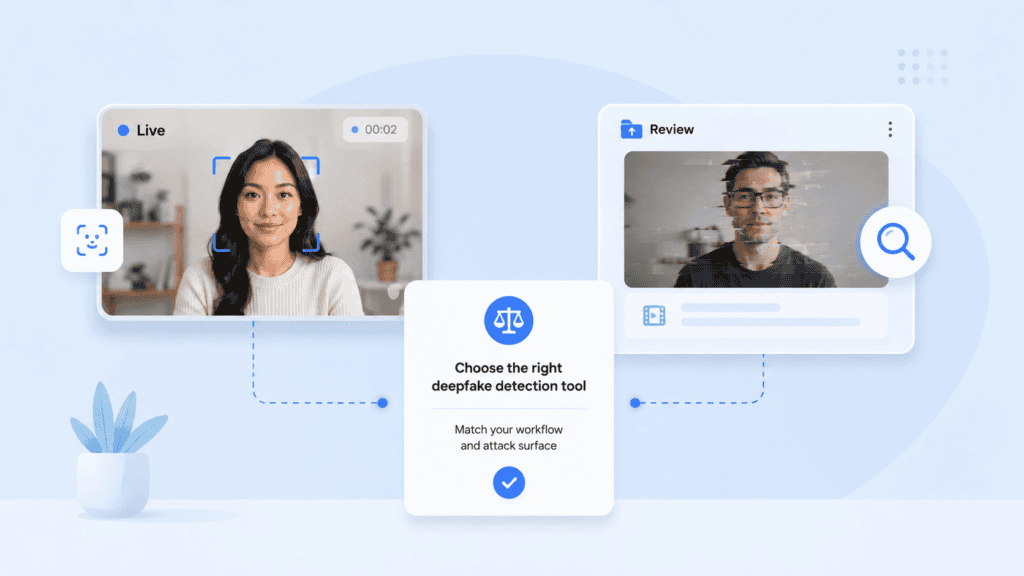
The best deepfake detection software is the product that matches the attack surface you actually have. Starting with a generic feature checklist can lead to buying extensive functionality while leaving the most important channel poorly protected.
First, identify the media entering the decision. A call center needs strong deepfake detection for audio. Remote onboarding needs selfie, video, injection, and liveness controls. A publisher may care more about forensic analysis of externally sourced images and video.
Next, decide whether you need live detection or post-event analysis. Real-time systems have strict latency requirements. A five-second delay may be acceptable for a manual file review but unusable in a live authentication flow.
For identity-related applications, avoid treating deepfake detection and liveness as substitutes. A genuine video replay may not technically be a generated deepfake, but it can still defeat a poorly designed authentication process. The guide to how deepfake detection works explains how media analysis, liveness, capture integrity, and identity checks can contribute different signals.
Provenance adds another layer. The C2PA Content Credentials specification defines a technical framework for cryptographically verifiable information about an asset’s origin and editing history. Provenance should still be treated as one signal rather than an automatic verdict that content is genuine.
How to test deepfake detection before deployment
A vendor demo with five obvious synthetic clips tells you very little about how a detector will behave inside your business. A better enterprise evaluation uses media that resembles production traffic.
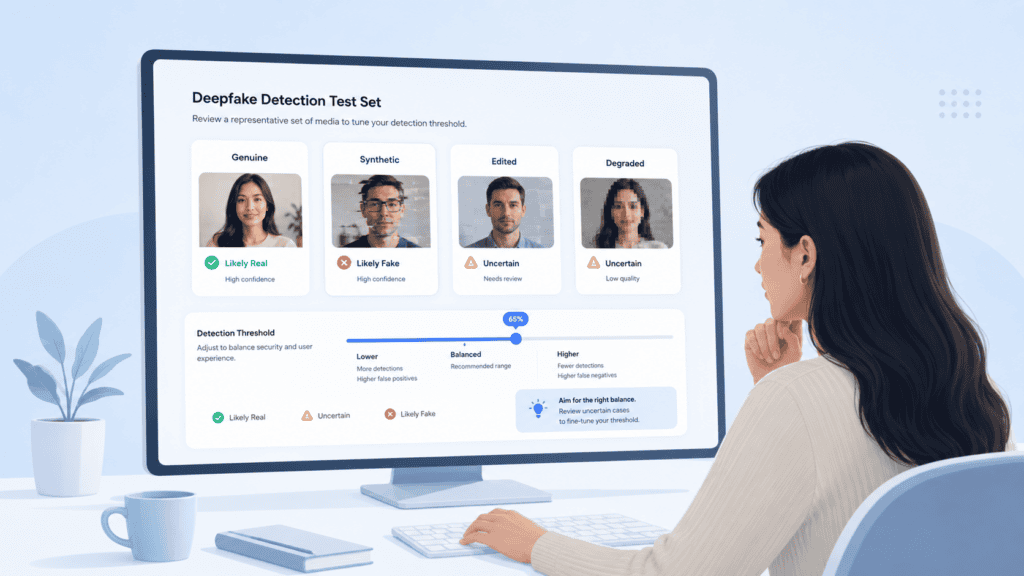
Build a test set with at least five groups: genuine media, obvious synthetic media, difficult current-generation deepfakes, benign edited media, and degraded media. The last two groups matter because compression, virtual backgrounds, poor microphones, low light, cropping, and network artifacts can create false alarms.
For a video onboarding workflow, for example, a useful internal test might contain 20 to 50 examples in each category. Include genuine users recorded on the same types of phones and webcams your customers use. Then add screen replays, face swaps, injected camera feeds, heavily compressed legitimate calls, and newer synthetic outputs.
Do not collapse the results into one “accuracy” figure. Track at least three operational measures:
- False acceptance rate: How often does malicious or synthetic content get through?
- False rejection rate: How often does legitimate content get flagged?
- Escalation rate: How much additional manual review will the tool create?
Run the same test after changing compression, file format, or call quality. A detector that performs well on original files but deteriorates after conferencing software recompresses the stream may not suit your actual use case.
Thresholds should also match the consequence of the decision. A social platform deciding whether to send a meme to human review can tolerate a different false-positive rate from a bank authorizing account recovery.
NIST’s synthetic-content evaluation work follows the same general principle: detection systems need testing across varying media and attack conditions rather than being judged from one headline metric. Its GenAI image discriminator evaluation plan provides an example of how structured evaluation can be approached.
The final step is to define what happens after a detection. “Deepfake score: 0.82” is not an incident-response plan. Decide whether the system should request a recapture, demand another authentication factor, pause an approval, route the interaction to an analyst, or block it entirely.
For identity verification, organizations should also test what happens when the content is genuine but the person presenting it is not. PrivateID’s guide to passive liveness detection explains how presentation attacks such as photos, screens, replays, and synthetic faces create a different problem from media classification alone.
Conclusion
There is no single deepfake detector that fits every enterprise.
Start with the workflow that carries risk, then choose the detection architecture around it. Live identity systems need liveness and capture integrity. Contact centers need strong synthetic speech analysis. Media and investigation teams need forensic evidence and explainability. High-volume platforms need APIs that can process content at scale.
The right product should reduce uncertainty at the moment your organization needs to decide whether a person, voice, image, or video can be trusted.
FAQs
What is the best deepfake detection software for enterprises?
There is no universal winner because enterprise requirements differ. PrivateID MediaSafe is suited to identity and live video workflows, Pindrop specializes in voice-centric environments, while Reality Defender, GetReal Security, Sensity AI, and Hive address broader or different detection needs.
Can deepfake detection software detect images as well as video?
Yes. Several platforms provide deepfake detection for images and video. Some can also distinguish between face manipulation and fully AI-generated content. Check whether the vendor analyzes individual image files, video frames, provenance, and other forensic signals relevant to your workflow.
What should enterprises use for deepfake detection for video?
For live video, prioritize low-latency processing, temporal analysis, injection-attack defenses, and integration with identity or meeting workflows. For recorded video, detailed forensic reporting and manipulation localization may be more important than millisecond response times.
Can deepfake tools detect AI-generated voices?
Yes. Several tools in this comparison provide audio or synthetic-voice analysis. Voice-focused enterprises should test performance across accents, languages, codecs, background noise, call quality, and the typical duration of speech in their actual workflow.
Is deepfake detection the same as liveness detection?
No. Liveness detection asks whether biometric input comes from a real, present person. Deepfake detection looks for evidence that media has been synthetically generated or manipulated. A secure identity workflow may need both because replay and injection attacks do not always fit neatly into one category.
How accurate are deepfake detection tools?
Accuracy varies by model, media type, generator, compression level, attack method, and decision threshold. A single vendor percentage should not be treated as universal performance. Enterprises should run representative internal tests and measure both false positives and false negatives under production conditions.
Can Content Credentials replace deepfake detection?
No. Content Credentials can provide cryptographically verifiable provenance information about how an asset was created or changed, which makes them useful authenticity signals. They do not guarantee that every piece of media carries complete provenance information, so forensic detection and workflow-specific security controls are still needed.