
 Back
Back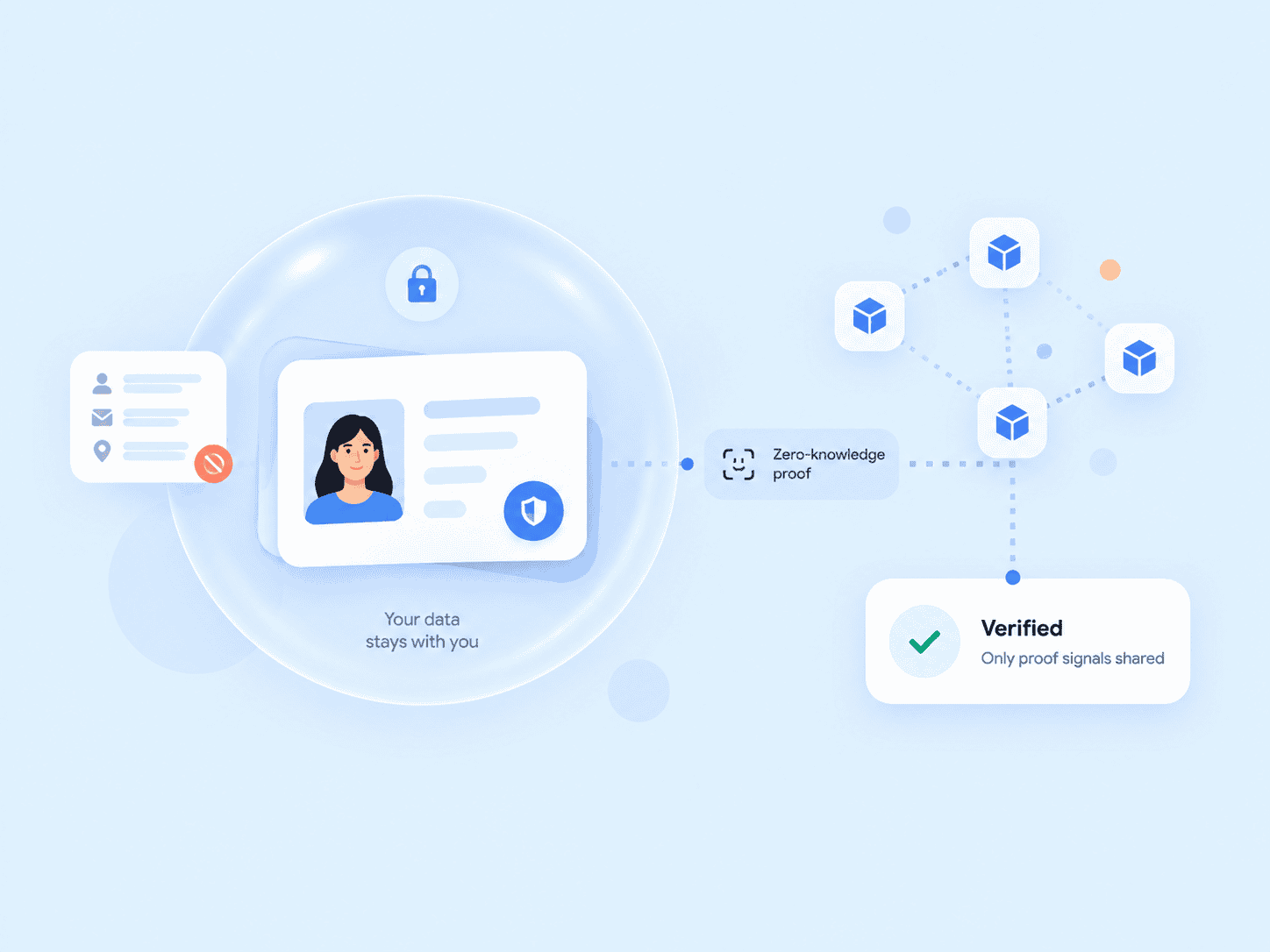
A blockchain can prove that a transaction happened, but it shouldn’t become a permanent database of passports, employee records, or biometric information. That distinction is central to understanding verifiable credentials blockchain architecture.
In a well-designed decentralized identity system, personal credentials usually stay with the holder. Cryptographic proofs establish whether a credential is authentic, while decentralized identifiers, public keys, status information, and sometimes blockchain records provide the trust infrastructure needed to verify it.
This article focuses on that boundary: what verifiable credentials do, where blockchain fits, what belongs off-chain, and how the complete identity flow works in practice.
Key Takeaways
- W3C verifiable credentials do not require a blockchain.
- A blockchain can provide a decentralized trust layer for identifiers, public keys, registries, or credential-status information.
- The credential itself normally belongs off-chain, under the holder’s control.
- Decentralized identifiers, or DIDs, can help verifiers discover the cryptographic information needed to authenticate an issuer.
- Signature validity alone doesn’t make a credential trustworthy. A verifier must also decide whether it trusts the issuer and whether the credential is still valid.
- Putting personally identifiable information directly on an immutable ledger creates serious privacy and lifecycle problems.
What Verifiable Credentials and Blockchain Actually Do
A verifiable credential is a cryptographically verifiable set of claims.
The familiar analogy is a physical driver’s licence. A government authority issues it, the driver possesses it, and another party can inspect it to determine whether to accept the claims printed on it.
A digital credential follows a similar model but replaces visual security features with cryptography.
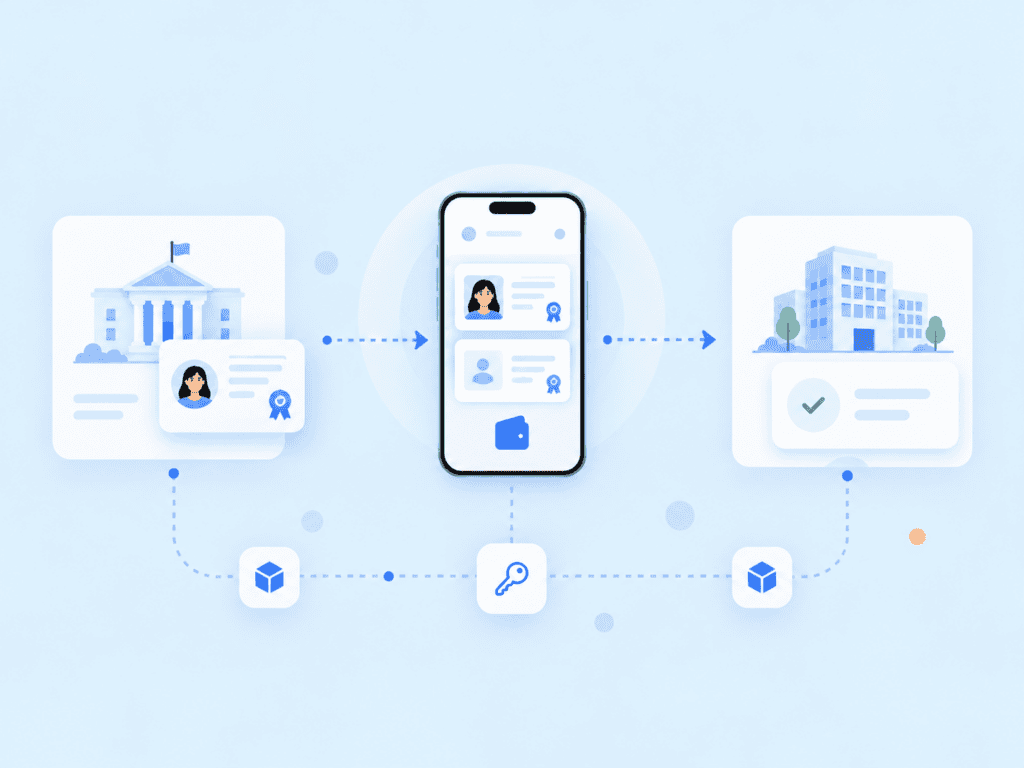
The W3C Verifiable Credentials Data Model 2.0 defines three important roles:
- Issuer: Creates the credential and makes claims about a subject.
- Holder: Possesses the credential and can present it.
- Verifier: Receives a presentation and determines whether to trust it.
The W3C published Verifiable Credentials Data Model 2.0 as a Recommendation in May 2025. It provides a standard way to represent credentials so that different systems can understand their structure.
For example, a university might issue a credential stating that Alice earned a specific degree. Alice stores that credential in her wallet. An employer can later verify its cryptographic proof rather than emailing the university to confirm the qualification manually.
That process doesn’t inherently require a blockchain.
This is where discussions of blockchain identity credentials often become misleading.
Verifiable credentials are not blockchain records
The credential is the portable proof held by the user or another holder. Blockchain is one possible mechanism for making parts of the surrounding trust infrastructure decentralized.
A blockchain might help answer questions such as:
- Which verification key belongs to this issuer?
- Has a decentralized identifier been updated?
- Is an issuer part of an approved registry?
- Was a particular registry state recorded at a certain point?
- Has the identifier’s controller changed its cryptographic keys?
It should generally not answer:
What is this person’s home address, date of birth, driver’s licence number, or biometric template?
Those are very different responsibilities.
PrivateID’s overview of verifiable credentials illustrates the practical end goal: credentials that users can access and share while identity verification remains tied to a secure credential lifecycle.
How Verifiable Credentials Blockchain Identity Works
A useful decentralized identity model has several separate components rather than one giant blockchain database.
At a high level, the flow looks like this:
Identity proofing → credential issuance → holder wallet → presentation → cryptographic verification → trust decision
Blockchain, when used at all, normally supports selected steps within that chain.
1. The issuer establishes a cryptographic identity
Suppose a professional licensing authority wants to issue digital licences.
It needs a cryptographic identity that verifiers can resolve and trust. One option is a decentralized identifier, or DID.
The W3C DID Core specification defines DIDs as identifiers designed for verifiable decentralized digital identity. A DID can resolve to a DID document containing information such as verification methods and public cryptographic keys.
A simplified DID might look like this:
did:example:7f3a91c2
Its DID document could conceptually contain:
{
“id”: “did:example:7f3a91c2”,
“verificationMethod”: [{
“id”: “did:example:7f3a91c2#key-1”,
“type”: “Multikey”,
“controller”: “did:example:7f3a91c2”,
“publicKeyMultibase”: “z6Mk…”
}]
}
Different DID methods determine how that document is created, updated, and resolved.
Some use distributed ledgers. Others do not.
This distinction matters because DID verifiable credentials and blockchain are related technologies, not inseparable technologies.
2. The issuer verifies the subject
Before issuing a high-assurance identity credential, the organization still needs to establish who the recipient is.
Blockchain doesn’t solve identity proofing.
If someone creates a blockchain address claiming to be Jane Smith, the network can prove control of that address. It cannot automatically prove that the controller actually is Jane Smith.
The issuer therefore needs an enrollment or identity-proofing process appropriate to the credential.
Depending on the use case, that might include:
- Identity document verification
- Biometric identity matching
- Authoritative database checks
- Employee onboarding
- In-person verification
- Existing account authentication
This is an important practical boundary. Cryptography can preserve a chain of trust after identity has been established, but poor identity proofing can still produce a perfectly signed credential containing the wrong person’s identity.
For organizations building reusable identity workflows, identity verification and credential issuance therefore need to be treated as connected but separate security controls.
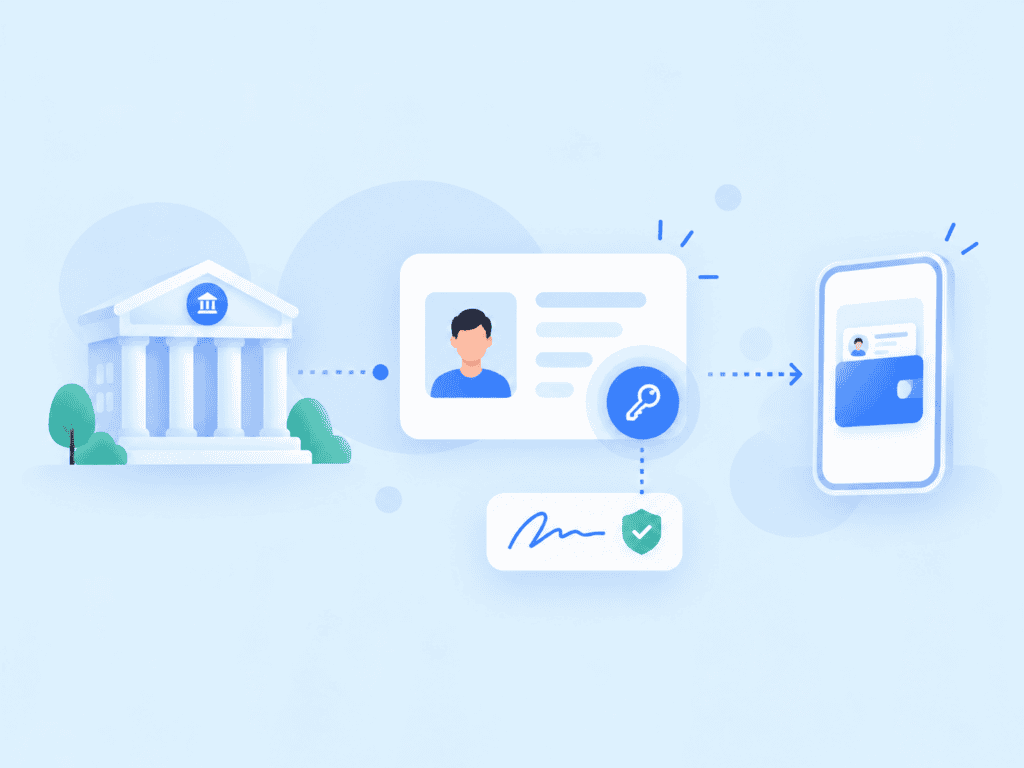
3. The issuer creates and signs the credential
After verification, the issuer creates the credential.
A simplified example might look like:
{
“@context”: [
“https://www.w3.org/ns/credentials/v2”
],
“type”: [
“VerifiableCredential”,
“EmployeeCredential”
],
“issuer”: “did:example:7f3a91c2”,
“validFrom”: “2026-09-01T00:00:00Z”,
“credentialSubject”: {
“id”: “did:example:holder123”,
“employeeStatus”: “active”,
“department”: “engineering”
}
}
The actual credential includes a securing mechanism that allows another system to verify authenticity and integrity.
The issuer’s private key creates the proof. A verifier uses the corresponding public verification material to check it.
If somebody alters “department”: “engineering” to “department”: “finance” after issuance, the cryptographic verification should fail.
That is one of the core properties of decentralized verifiable credentials: trust is based on verifiable cryptographic assertions rather than the visual appearance of a document.
4. The holder stores the credential
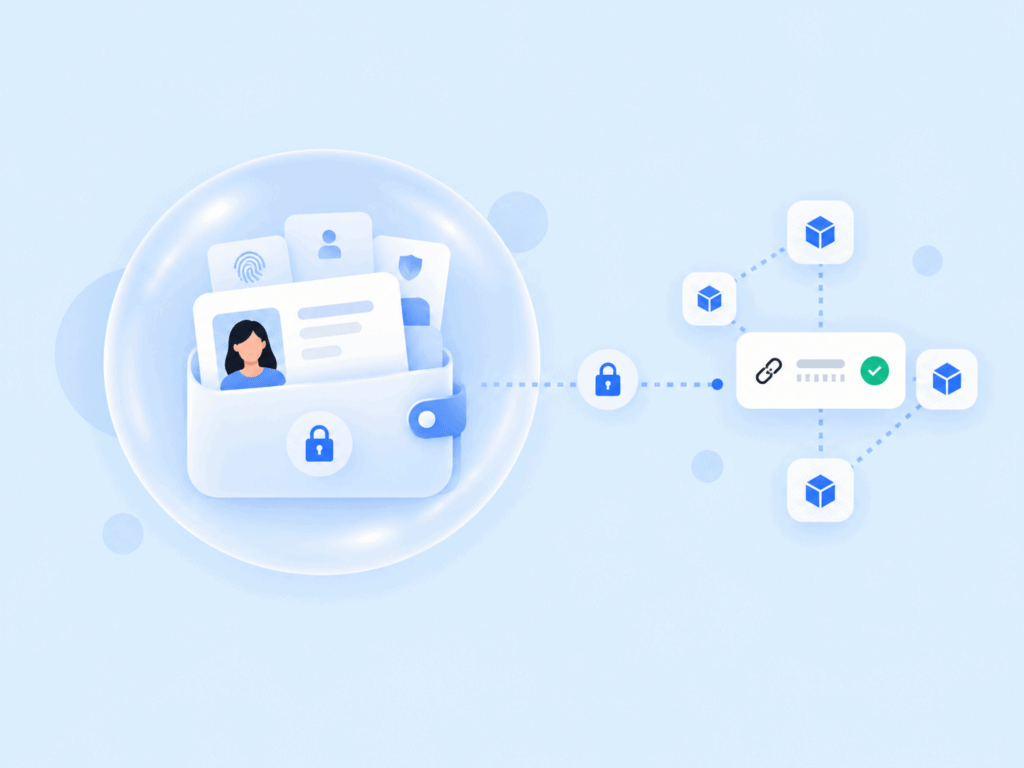
The credential is delivered to a wallet or another credential-management environment controlled on behalf of the holder.
This is where good architecture diverges sharply from the idea of “putting identity on the blockchain.”
The credential can remain off-chain.
The holder doesn’t need every verifier to retrieve their complete personal record from a public ledger. Instead, the holder presents the appropriate credential, or selected information derived from it, when required.
A web wallet is one possible implementation. Native mobile wallets are another.
5. The holder presents evidence to a verifier
Imagine that the employee from the previous example enters a restricted contractor portal.
The portal doesn’t necessarily need the employee’s entire identity profile. It might need to establish only:
- The credential came from an accepted employer.
- The credential hasn’t expired.
- The employee is currently active.
- The credential belongs to the presenter.
The holder supplies a verifiable presentation containing the information required by that transaction.
The verifier then evaluates the presentation.
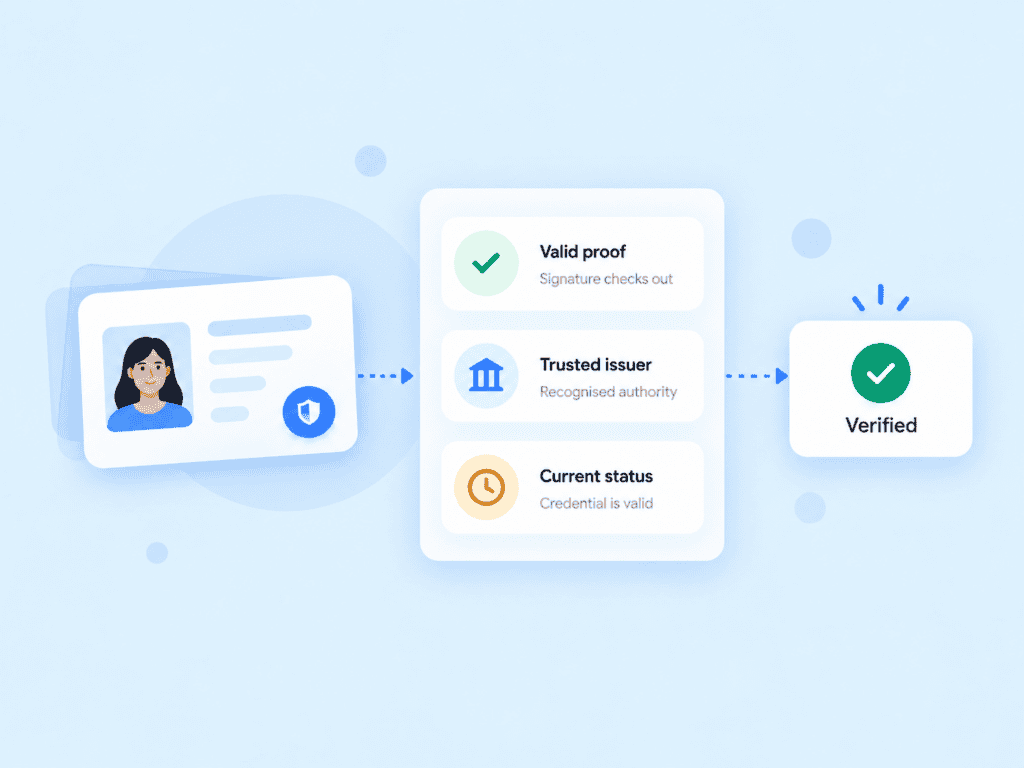
6. The verifier checks cryptography and trust
Verification is more than checking whether JSON contains a valid signature.
A production system might evaluate:
1. Is the credential structurally valid?
2. Is its cryptographic proof valid?
3. Can the issuer’s verification method be resolved?
4. Do we trust this issuer for this type of claim?
5. Is the credential currently valid?
6. Has its status changed or been revoked?
7. Is the presentation fresh rather than replayed?
8. Does the presenter demonstrate appropriate control?
9. Does the credential satisfy this transaction’s policy?
Blockchain may contribute to steps three through six depending on the architecture.
The final step is particularly important.
Cryptographic validity is not the same as business trust.
Anyone with a signing key can potentially sign data. A verifier still needs policy stating which organizations are authorized to issue credentials it accepts.
That is a practical distinction that often gets lost when decentralized identity is described as “trustless.”
The system doesn’t eliminate trust. It changes how trust is established, communicated, and verified.
What Should and Should Not Be Stored on a Blockchain
The most useful way to understand verifiable credentials blockchain design is to separate public trust infrastructure from private identity data.
Good candidates for decentralized infrastructure
Depending on the implementation, a blockchain or distributed ledger may hold or anchor:
- Decentralized identifier operations
- Public-key references
- Issuer registries
- Trust-registry entries
- Schema identifiers
- Credential-status infrastructure
- Cryptographic hashes or commitments
- Timestamps or integrity anchors
These values can help independent parties establish a common view of trust state without requiring a single identity provider to control the registry.
Personal credentials should normally stay off-chain
Consider a credential containing:
{
“fullName”: “Alice Example”,
“dateOfBirth”: “1993-04-12”,
“address”: “123 Example Street”,
“employeeId”: “784291”
}
Writing those values directly to an immutable public blockchain would create obvious problems.
The user might be unable to meaningfully delete the information. Every node might preserve a copy. Data written today could remain available long after the original business purpose disappears.
Encryption doesn’t automatically solve the problem either.
Encrypted data recorded permanently today may remain available for future cryptanalysis. Key loss or compromise also becomes a lifecycle problem.
A safer model looks more like:
ON-CHAIN / SHARED TRUST LAYER
—————————–
Issuer identifier
Public verification material
Status references
Trust registry
Cryptographic commitments
OFF-CHAIN / HOLDER CONTROL
————————–
Name
Date of birth
Address
Licence details
Employment attributes
Health information
Other personal claims
The W3C credential architecture supports privacy-respecting credentials without requiring a global personal-data ledger. Its broader credential specification family includes mechanisms addressing credential securing and status, reinforcing the distinction between a credential’s content and the infrastructure used to validate it.
Even hashes need careful treatment
A common suggestion is: “Just hash the personal information and put the hash on-chain.”
That isn’t automatically privacy-preserving.
If the input comes from a small or predictable set, an attacker can calculate possible values and compare the resulting hashes.
Imagine anchoring:
SHA256(“Alice Example|1993-04-12”)
An attacker who already suspects Alice’s name and approximate age can test candidate birth dates until a hash matches.
Cryptographic commitments typically require stronger designs, including appropriate randomness and protocols designed for the disclosure model being implemented.
Simply replacing personal data with a raw hash doesn’t remove the need for privacy engineering.
How Decentralized Credentials Are Verified in Practice
A realistic identity transaction helps make the architecture concrete.
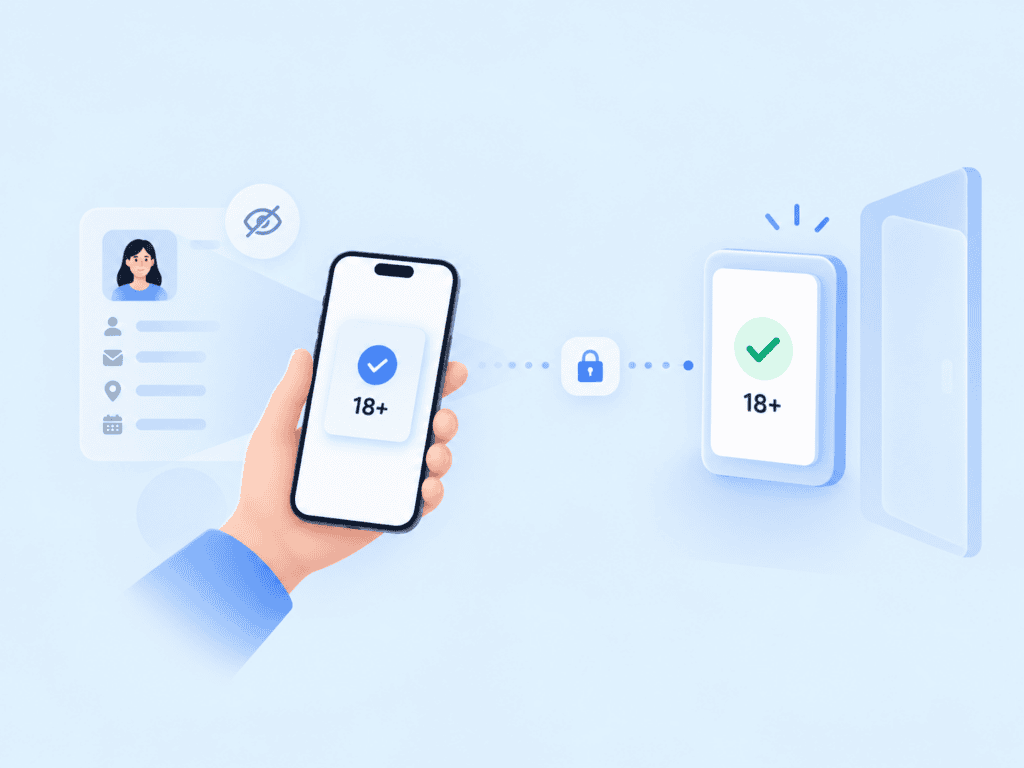
Consider an online service that must confirm that a user is at least 18 without collecting a copy of the user’s identity document.
Step one: initial identity proofing
An approved issuer verifies the user’s identity and date of birth through an appropriate identity-proofing flow.
The user’s raw document doesn’t need to become part of the blockchain.
Step two: credential issuance
The issuer creates a credential asserting an age-related attribute.
Depending on the credential design, the credential could contain a date of birth, an age threshold, or a derived claim.
For privacy, a narrow claim is often preferable when that’s all future verifiers require.
For example:
{
“credentialSubject”: {
“ageOver”: 18
}
}
Step three: storage
The credential is stored in the user’s credential wallet.
The issuer’s public verification information can remain independently discoverable through the ecosystem’s trust mechanism.
Step four: presentation
The website asks the wallet for evidence that the user satisfies the required age threshold.
The wallet creates the requested presentation rather than uploading a photograph of the original ID every time.
Step five: verification
The service checks:
- The issuer
- The proof
- Credential validity
- Credential status
- Required attributes
- Presentation freshness
- Its own issuer-trust policy
It doesn’t need to phone the issuer for every transaction, nor does it necessarily need to retain the identity document used during initial proofing.
This is where credential systems can reduce unnecessary data circulation.
The broader concept is also relevant to decentralized authentication frameworks, where identity and authentication functions can be distributed rather than tied exclusively to a single central identity provider.
Blockchain is only one possible trust mechanism
One of the most important facts about blockchain digital identity is also one of the simplest:
You can build W3C verifiable credentials without blockchain.
The W3C credential model doesn’t require Ethereum, Bitcoin, a private distributed ledger, or any other particular blockchain.
Likewise, although DIDs are decentralized identifiers, not every DID method relies on a blockchain.
An architecture could instead use mechanisms such as:
- Web-based identifiers
- Conventional PKI
- Managed trust registries
- Consortium infrastructure
- Other decentralized data systems
Blockchain becomes useful when its specific properties solve a real trust problem, such as multiple independent organizations needing to maintain or verify shared public state without assigning one participant complete control.
Using blockchain simply because the application deals with credentials adds complexity without necessarily improving security.
Where Blockchain Digital Identity Makes Sense
The decision to use blockchain should come from the trust model, not from the word “identity.”
Cross-organization credential ecosystems
Suppose hundreds of universities issue credentials that thousands of employers need to verify.
A shared trust layer could make it easier for verifiers to determine which issuer identifiers and keys correspond to recognized institutions without integrating separately with every university.
The credentials themselves can still remain off-chain.
Professional licensing
Licensing authorities could issue credentials representing active professional status.
A verifier might check a decentralized registry or status mechanism to determine whether the issuing authority is recognized and whether relevant trust information has changed.
Again, the public infrastructure doesn’t need a permanent ledger entry containing the professional’s personal address and licence history.
Workforce and contractor identity
Large organizations often need identities that work across employers, suppliers, facilities, and third-party systems.
Portable credentials can allow an approved issuer to make assertions such as:
- Contractor identity verified
- Required certification completed
- Access eligibility valid
- Employment relationship active
The verifier makes an independent decision based on the signed credential and its own policies.
Reusable identity proofing
A user may complete high-assurance proofing once and receive a credential that can be presented during subsequent onboarding processes.
This model can reduce repeated collection of sensitive identity documents, provided receiving organizations accept the issuer, proofing level, credential format, and presentation mechanism.
PrivateID’s discussion of the future of verifiable credentials and digital trust explores this broader movement toward portable credentials, wallets, and cross-organization verification.
When blockchain adds little value
A distributed ledger may be unnecessary when:
- One organization controls every issuer and verifier.
- Existing PKI already solves key distribution.
- There is no shared-state problem.
- Participants already trust a central registry.
- Blockchain operations create unacceptable cost or latency.
- Privacy requirements make the proposed ledger design difficult to justify.
- Recovery and governance become harder than the problem being solved.
A centralized trust registry isn’t automatically inferior. For some applications, it is simpler to operate, easier to govern, and entirely appropriate.
Decentralization should solve a trust or control problem, not create one.
Conclusion
The defining feature of decentralized identity isn’t putting people’s identities on a blockchain. It is allowing independently verifiable credentials to move between issuers, holders, and verifiers without making one central identity database responsible for every transaction.
In a sound architecture, personal credentials usually stay under the holder’s control. Cryptographic proofs protect integrity. DIDs or other identifiers expose verification information. A blockchain can provide shared trust infrastructure when decentralization genuinely matters.
That separation is the useful way to evaluate any verifiable credentials blockchain system: identify exactly what the ledger is responsible for, what remains private, and what evidence a verifier actually needs before trusting a credential.
FAQs
Do verifiable credentials require blockchain?
No. The W3C Verifiable Credentials Data Model doesn’t require blockchain technology. Credentials can use other trust and key-management architectures, while blockchain is an optional mechanism for decentralized identifiers, registries, status information, or other shared trust infrastructure.
What is the difference between a DID and a verifiable credential?
A DID is an identifier that can be associated with cryptographic verification methods and other information through a DID document. A verifiable credential contains claims issued about a subject. A credential may reference DIDs for issuers or subjects, but the two standards perform different functions.
Are verifiable credentials stored on the blockchain?
They don’t have to be, and sensitive credentials generally shouldn’t be placed directly on a public immutable ledger. A credential is commonly stored by the holder, while a blockchain may contain public verification information, registry data, identifiers, or cryptographic references.
Can blockchain prove someone’s real-world identity?
Not by itself. A blockchain can prove possession of cryptographic keys and preserve shared state, but an issuer still needs an identity-proofing process to connect those keys or credentials to a real person when real-world identity matters.
Are W3C verifiable credentials the same as NFTs?
No. W3C verifiable credentials are cryptographically verifiable claims designed for credential exchange between issuers, holders, and verifiers. NFTs are blockchain tokens representing ownership or association with a tokenized asset and operate under a different model.
What happens if a verifiable credential is revoked?
A verifier can consult the credential’s applicable status mechanism before accepting it. The exact approach depends on the credential ecosystem, and privacy matters because poorly designed revocation checks can allow issuers or infrastructure providers to track where a credential is being presented.
Is decentralized identity completely trustless?
No. Cryptography reduces certain dependencies, but verifiers must still decide which issuers they trust, which credential types they accept, and which policies a presentation must satisfy. Decentralized identity redistributes trust rather than eliminating it.