
 Back
Back
Choosing a verifiable credentials platform is no longer just a question of whether a vendor can issue a cryptographically signed credential. The harder questions are whether that credential works with other wallets, how revocation is handled, what the verifier actually checks, where personal data travels, and how the system fits your existing identity stack.
This guide compares ten current options through that buyer’s lens. The focus is on practical differences between platforms for organizations evaluating W3C verifiable credentials, mobile identity, workforce credentials, reusable identity proofing, and decentralized identity infrastructure.
Key takeaways
- A strong platform should cover the full credential lifecycle, not issuance alone.
- Standards support needs to be checked at the protocol, credential-format, wallet, and cryptographic levels.
- Microsoft, Okta, Auth0, IBM, and Ping Identity increasingly connect digital credentials with broader identity and access management.
- MATTR, SpruceID, Affinidi, and cheqd offer more specialized digital credential infrastructure.
- Privacy architecture matters as much as interoperability, especially when credentials begin with identity proofing or biometric verification.
What to look for in a verifiable credentials platform
The World Wide Web Consortium published the Verifiable Credentials Data Model v2.0 as a Recommendation in May 2025. It defines the basic issuer, holder, and verifier model behind W3C verifiable credentials.
That standard is a starting point, not a complete procurement checklist.
Two platforms can both advertise W3C support and still behave very differently in production. One may concentrate on employee credentials inside an existing identity tenant. Another may give developers APIs for building an independent credential network. A third may combine credential issuance with identity proofing.
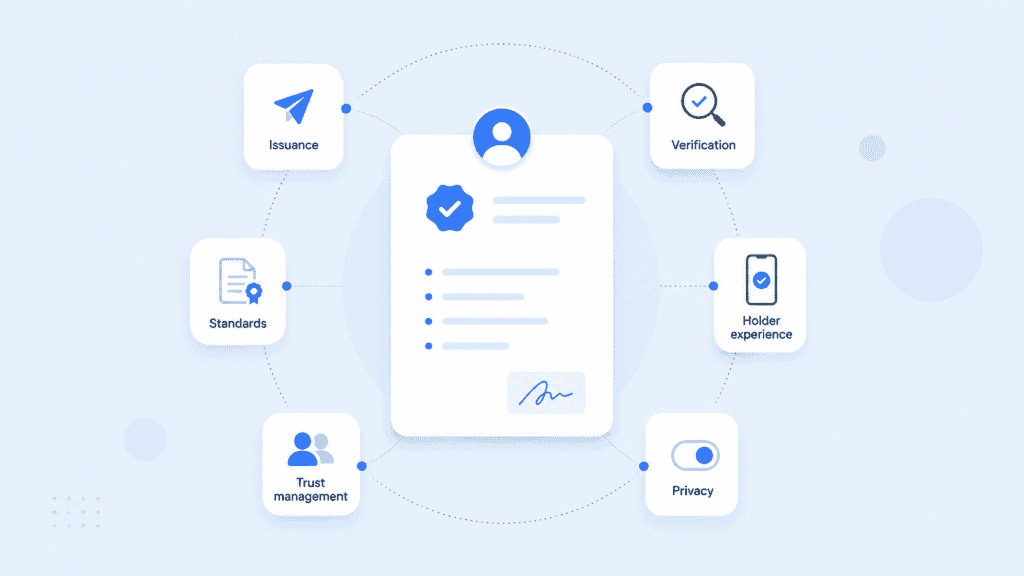
When comparing verifiable credentials software, look at six areas:
| Evaluation area | What to check |
| Issuance | Credential creation, schemas, signing, expiration, renewal, and bulk or automated issuance |
| Verification | Signature checks, issuer trust, credential status, presentation policies, and selective disclosure |
| Standards | W3C VC versions, OID4VCI, OID4VP, SD-JWT VC, mdoc, DID methods, and status mechanisms |
| Holder experience | Built-in wallet, browser wallet, mobile SDK, or compatibility with third-party wallets |
| Trust management | How your application determines which issuers, keys, certificates, and credential types it accepts |
| Privacy | What personal information reaches the platform, what is retained, and whether verification can minimize disclosure |
The last point is easy to underestimate. A credential may be cryptographically portable while the enrollment process that created it still collects sensitive documents, selfies, or identity attributes centrally.
Organizations considering reusable verified identities should therefore evaluate the credential layer together with the initial identity verification workflow, rather than treating them as unrelated systems.
Top 10 verifiable credentials platforms
This comparison is ordered by breadth of fit rather than claiming that one vendor is universally superior. The right choice depends on whether you need identity proofing, enterprise IAM integration, government-grade mobile credentials, developer infrastructure, or a decentralized trust network.
1. PrivateID
PrivateID is a useful fit when the credential itself is only one part of the identity journey. Its offering combines verified credential issuance with browser-accessible wallets, identity proofing, and privacy-preserving biometric authentication.
The platform’s distinctive approach is its browser-based model. Users can access and share credentials without the organization having to make a dedicated mobile wallet the only route into the system. PrivateID also supports white-labeled credentials for workflows such as customer identity, workforce access, age assurance, and expedited enrollment.
That makes it particularly relevant when an organization needs to establish who the user is before issuing the credential. Its broader verifiable credentials platform sits alongside document verification, liveness, face matching, and identity assurance capabilities.
Best fit: Organizations that want credential issuance connected to privacy-focused identity proofing, browser-based access, biometrics, or reusable customer identity.
Check during evaluation: Credential formats required by external wallets and relying parties, supported trust models, status handling, and interoperability requirements for your specific ecosystem.
2. Microsoft Entra Verified ID
Microsoft Entra Verified ID is one of the more natural options for organizations already operating heavily inside Microsoft Entra.
It supports issuance and verification workflows, REST APIs, organization identifiers, and credential management. Microsoft also connects Verified ID with identity recovery and other Entra workflows, which is useful when digital identity credentials need to support an existing workforce or enterprise access environment.
An important distinction is that a verifiable credential does not replace every authentication mechanism. Microsoft, for example, distinguishes Verified ID identity proof from authentication methods used for sign-in or multifactor authentication.
Best fit: Microsoft-centric enterprises that want digital credentials tied closely to their existing identity administration.
Check during evaluation: The exact standards and credential formats supported by the deployment you plan to use. Microsoft has evolved its decentralized identity architecture over time, so do not assume that every W3C or OpenID credential profile is interchangeable.
3. Okta
Okta has moved beyond simply discussing verifiable credentials as an identity concept. Its current digital credential architecture includes issuance and verification capabilities and support for modern credential formats such as SD-JWT VC and mdoc.
That makes Okta verifiable credentials especially relevant to organizations that want reusable credentials within a larger identity security program rather than operating a separate credential stack.
This is also an example of why buyers should inspect individual protocol support instead of asking whether a provider “supports VCs.” Issuance, mdoc verification, SD-JWT VC verification, Digital Credentials API integration, and presentation protocols are separate capabilities.
Best fit: Enterprises already using Okta that want credential verification or issuance connected to existing authentication and identity journeys.
Check during evaluation: Which formats can be issued versus only verified, wallet compatibility, browser Digital Credentials API support, and availability within your Okta product package.
4. Auth0
Auth0 deserves separate consideration even though it is part of Okta because its implementation surface is aimed strongly at application developers.
Current Auth0 verifiable credentials capabilities include verification templates and application flows that can request a credential from a digital wallet. One practical example is mobile driver’s license verification during an authentication journey, where a user receives a QR code or same-device interaction and presents a qualifying credential.
This makes Auth0 interesting when the principal requirement is not to operate a broad credential ecosystem but to let an application consume digital credentials during login, onboarding, or another user flow.
Best fit: Development teams that already use Auth0 and want credential presentation inside application authentication journeys.
Check during evaluation: Whether your project needs issuance as well as verification. Make sure Auth0’s available credential formats and issuer-trust configuration cover the broader lifecycle before treating it as a full replacement for specialized credential infrastructure.
5. IBM Verify Digital Credentials
IBM has continued building digital credential functionality into its identity products. Current IBM verifiable credentials capabilities include issuance, credential definitions, wallet interaction, credential-status management, and support for multiple credential technologies.
IBM’s documentation also shows support for standards used outside traditional W3C JSON-LD deployments, including mdoc and selective-disclosure credential formats. That breadth matters for enterprises that expect digital identity credentials to cross online and in-person use cases.
For organizations already operating IBM Verify Identity Access, the ability to connect credentials with established access infrastructure is a significant consideration.
Best fit: Large enterprises using IBM security and access products that need digital credentials as another component of their identity architecture.
Check during evaluation: Product edition, feature availability, supported OpenID flows, and differences between IBM Verify and IBM Verify Identity Access deployments.
6. PingOne Credentials
PingOne Credentials is designed explicitly around creating, issuing, managing, presenting, and revoking digital verifiable credentials.
Its enterprise IAM heritage is important. Credential policies can connect with Ping identities and wallet experiences while developers can work with credential APIs. Support includes issuer and verifier identifiers, custom credentials, wallet management, issuance rules, and OpenID-based credential issuance.
This gives PingOne a clearer credential lifecycle than an IAM product that only accepts an external wallet during authentication.
Best fit: Enterprises using the Ping Identity ecosystem that need managed credential issuance and verification.
Check during evaluation: Licensing. Credential functionality can depend on whether PingOne Credentials is included in the organization’s product configuration.
7. MATTR
MATTR is one of the more specialized verifiable credentials companies in this comparison. Its product family separates cloud credential infrastructure, SDKs, and deployable holder or verifier experiences.
MATTR VII provides the backend credential platform. It supports issuance, management, verification, REST APIs, credential configuration, claims sources, and administration. MATTR Pi provides SDK-level capabilities, while MATTR GO provides faster routes to branded credential applications.
Its current platform work is especially relevant to mobile documents and open credential protocols. MATTR has aligned issuance capabilities with OpenID for Verifiable Credential Issuance and provides tooling for formats including mdoc.
Best fit: Government, regulated identity, and large digital credential programs requiring a configurable issuer, verifier, and wallet architecture.
Check during evaluation: The credential formats you actually need. MATTR offers several technologies, but format support can differ between issuance, holding, and verification components.
8. SpruceID
SpruceID is strongly oriented toward interoperable digital identity infrastructure, with significant emphasis on government digital credentials.
Its technology supports credential issuance, verification, holder experiences, and standards such as W3C Verifiable Credentials, mobile driver’s licenses, SD-JWT, and OpenID presentation protocols. It is particularly relevant where credentials have to work both online and in person.
SpruceID’s positioning also illustrates an important procurement distinction. Some deployments are primarily about decentralized identity and verifiable credentials, while others are specifically mobile identity programs where ISO mobile-document standards are just as important as W3C VCs.
Best fit: Government agencies and programs building mobile IDs, resident credentials, professional credentials, or cross-agency digital identity.
Check during evaluation: Required wallet ecosystems, mobile document standards, trust-list governance, verifier infrastructure, and accessibility requirements.
9. Affinidi Elements
Affinidi Elements provides a managed verifiable credentials stack focused on standards-based issuance and verification.
Its current offering includes credential issuance through OID4VCI, presentation through OID4VP, credential schema management, multi-wallet support, verification tooling, and an associated user-controlled wallet. It also provides developer libraries across several languages.
The platform is particularly relevant when an engineering team wants an API-driven credential service without building every issuer and verifier component itself.
Best fit: Development teams building applications that need reusable W3C credentials, external wallets, and privacy-oriented data exchange.
Check during evaluation: Which credential formats your target wallets support, how issuer trust is established, and whether Affinidi’s broader wallet and trust-network components are required for the planned deployment.
10. cheqd Studio
cheqd takes a more infrastructure-oriented approach to decentralized identity and verifiable credentials.
cheqd Studio exposes REST APIs for creating and resolving decentralized identifiers, issuing and verifying credentials, revocation, suspension, credential-status lists, presentations, and trust registries. This can be attractive where the team wants to build a custom credential ecosystem while avoiding direct implementation of lower-level decentralized identity components.
Trust registries are particularly relevant for multi-issuer ecosystems. Checking a valid signature tells a verifier that a credential was signed by a particular key. It does not automatically tell the verifier whether that issuer should be trusted for the claim being presented.
Best fit: Developers and ecosystem operators that want configurable DID, credential, status, and trust-registry infrastructure.
Check during evaluation: Dependence on cheqd-specific DID infrastructure, wallet compatibility, governance requirements, and how easily credentials can move into environments that use different trust mechanisms.

How to test verifiable credentials software
A vendor demonstration can make issuance look deceptively simple: scan a QR code, receive a credential, and present it back.
A better evaluation tests what happens after that happy path.
Use the same six-part proof scenario with every shortlisted verifiable credentials platform:
- Issue one realistic credential. Use the fields and assurance level your production workflow would require, not a generic employee badge.
- Present it to a separate verifier. The verifier should not simply be another screen inside the issuer’s dashboard.
- Modify one signed claim. Confirm that the tampered credential fails cryptographic verification.
- Revoke or suspend the credential. Test how long it takes before the verifier rejects it and what happens if the status service cannot be reached.
- Request fewer attributes. For an age scenario, ask only for the proof required rather than accepting name, address, and full date of birth.
- Try another wallet or verifier. This is where claims of interoperability become measurable.
The fifth test is particularly important. A platform may technically support digital credentials while its default workflows still encourage unnecessary disclosure.
PrivateID’s explanation of the future of verifiable credentials and digital trust gives a useful example: an age credential can prove that someone meets an age threshold without requiring the verifier to receive every identity attribute stored in the original credential.
You should also document one failure path. For example, what does your application do when a credential has a correct signature but was issued by an organization your policy does not trust? That question exposes the difference between cryptographic validity and business trust.

W3C credentials, DIDs, and OpenID protocols
Buyers often use “W3C compliant” as shorthand for interoperability. That is too broad.
The W3C data model defines how verifiable credential information is represented, but an operational credential system also needs a way to issue, request, present, and validate those credentials.
The OpenID Foundation’s OpenID for Verifiable Credential Issuance 1.0 defines an API and authorization framework for delivering credentials to holders. OpenID for Verifiable Presentations 1.0 defines how a verifier requests and receives credentials.
That leads to a more useful standards checklist:
- What credential data models and formats can the platform issue?
- Does it support the final OID4VCI and OID4VP specifications required by your other systems?
- Which wallet applications have actually been tested?
- Which DID methods, certificate chains, or other issuer identifiers establish trust?
- How does the verifier discover credential status?
- Can the holder disclose only the required claims?
- Can another vendor verify the credential without a proprietary callback to the original platform?
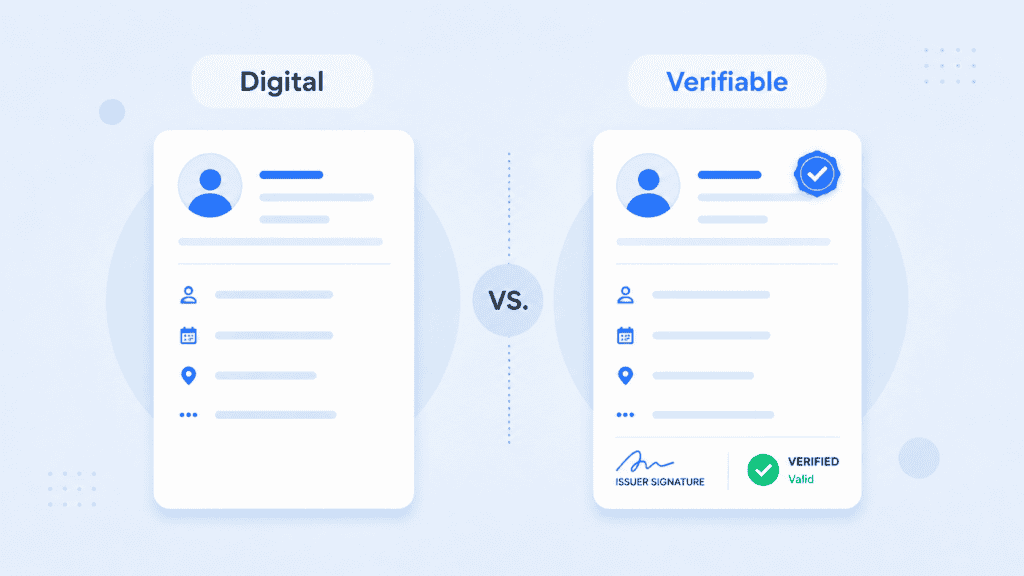
The phrase decentralized identity and verifiable credentials can also create confusion. A W3C credential does not require every part of the architecture to be decentralized. Microsoft, enterprise IAM vendors, government PKI systems, and decentralized networks can all implement credentials with different trust mechanisms.
Choose the trust architecture first. Then choose software capable of implementing it.
Conclusion
A verifiable credential project succeeds when the credential remains trustworthy outside the product screen where it was created.
Before choosing a vendor, test issuance, external verification, revocation, selective disclosure, wallet interoperability, and issuer trust using one realistic credential. That exercise usually reveals more than a feature matrix.
The strongest choice is the platform whose identity proofing, credential formats, trust model, privacy architecture, and existing infrastructure match the way your credentials will actually be used.
FAQs
What is a verifiable credentials platform?
A verifiable credentials platform provides infrastructure for creating, signing, issuing, managing, presenting, and verifying digital credentials. Depending on the provider, it may also include wallets, identity proofing, credential schemas, revocation, selective disclosure, and trust registries.
What are W3C verifiable credentials?
W3C verifiable credentials are digitally signed sets of claims structured according to the W3C Verifiable Credentials Data Model. The model defines relationships between the issuer that creates a credential, the holder that possesses it, and the verifier that checks it.
What is the difference between a digital credential and a verifiable credential?
A digital credential can be any electronic representation of a qualification or identity attribute. A verifiable credential adds cryptographic mechanisms that allow a verifier to check its issuer and integrity rather than trusting the appearance of a PDF, image, or database record.
Does Microsoft Entra support verifiable credentials?
Yes. Entra verifiable credentials are provided through Microsoft Entra Verified ID. The service supports credential issuance and verification and can connect credential-based identity proof with other Microsoft Entra workflows.
Does Auth0 support verifiable credentials?
Yes. Current Auth0 verifiable credentials functionality includes credential verification workflows and templates for requesting digital credentials such as mobile driver’s licenses. Buyers should confirm whether their use case needs broader issuance and lifecycle capabilities in addition to Auth0’s verification features.
Does Okta support verifiable credentials?
Yes. Okta verifiable credentials capabilities include digital credential issuance and verification, with support varying by format and workflow. Organizations should check which credential formats can be issued, which can be verified, and which product capabilities are available in their environment.
Does IBM support verifiable credentials?
Yes. Current IBM verifiable credentials functionality is available through IBM’s digital credential capabilities, including issuance, verification, wallet interactions, credential definitions, and status management. Exact functionality varies between IBM identity products and releases, so implementation requirements should be checked before procurement.